.svg)
.svg)
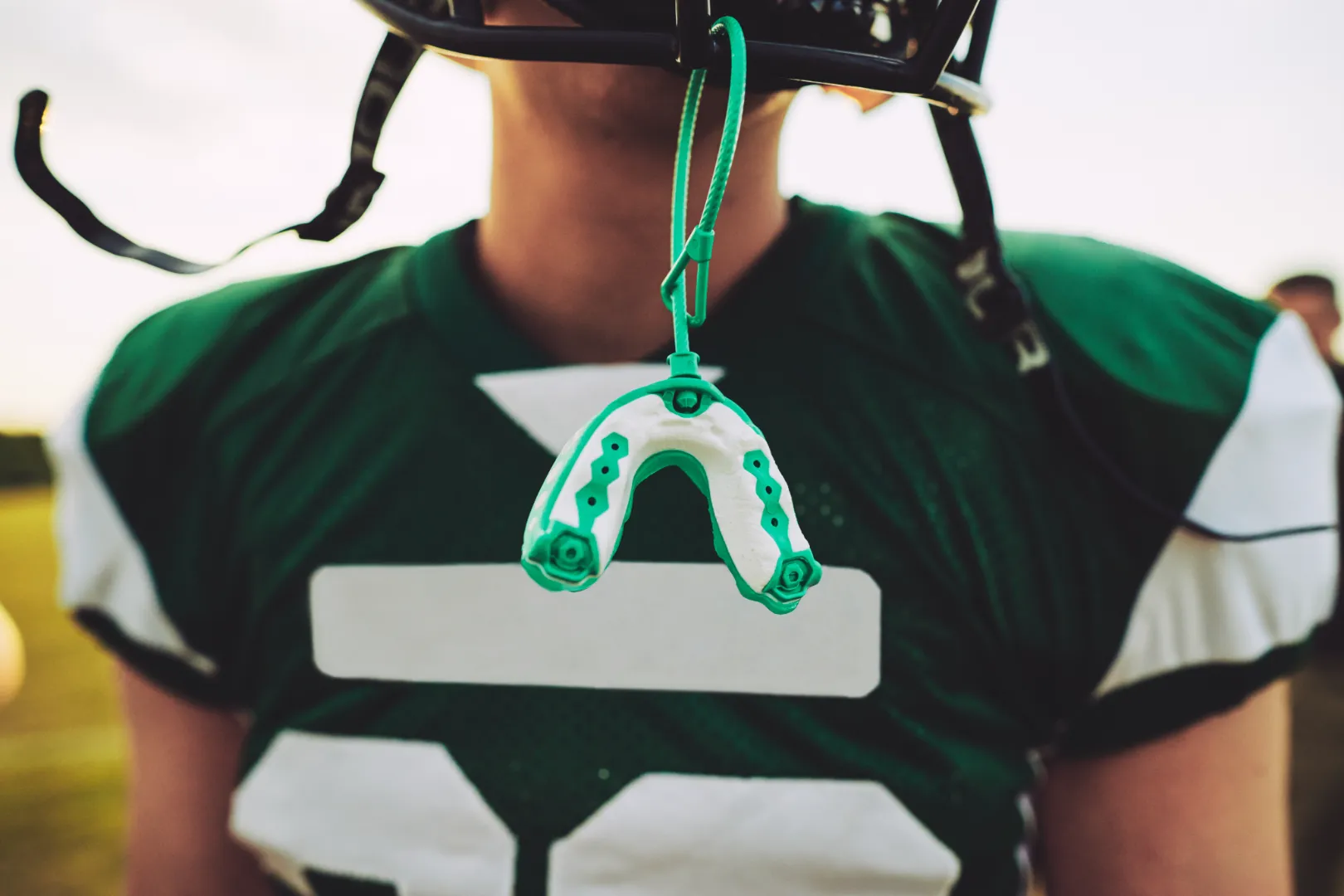
Occlusal & Sports Guards in Fulshear, TX
Teeth are remarkably durable, but they do not recover from grinding or a hit to the mouth. At Gavri Orthodontics, our board-certified orthodontists Dr. Aaron Gavri and Dr. Mary Kate Gavri make custom-fitted occlusal guards for clenching and grinding, and custom sports guards for athletes across Fulshear, Richmond, Katy, Cinco Ranch, and Sugar Land. Both are made from a digital scan, so they fit properly and get worn. Call (281) 407-5871.
Two Different Guards, Two Different Jobs
These appliances are often grouped together because both are custom mouth guards, but they solve unrelated problems and are built differently.
An occlusal guard, also called a night guard or bite guard, manages the sustained force of clenching and grinding. The pressure involved is slow, repetitive, and applied for hours at a time, usually during sleep. The guard's job is to absorb that force and keep the upper and lower teeth from wearing against each other.
A sports guard handles the opposite problem: a single sudden impact. Its job is to spread the energy of a blow across a wide surface so no individual tooth takes the whole load, and to cushion the soft tissue of the lips and cheeks.
One will not do the other's work. A sports guard is too bulky and too soft to wear all night, and an occlusal guard is too rigid and too thin to absorb a collision safely. Patients who need both protection types need two appliances.
Occlusal Guards for Grinding and Clenching
Signs you may be grinding
Bruxism happens mostly during sleep, which is why most people have no idea they do it. The signs show up elsewhere.
- Waking with a sore, tight, or tired jaw
- Headaches concentrated around the temples, particularly in the morning
- Teeth that look flattened, chipped, or worn at the biting edges
- Increased tooth sensitivity, especially to cold
- Clicking or popping in the jaw joint
- Tooth pain with no visible decay
- A partner who hears the grinding at night
If several of these sound familiar, it is worth an examination. Grinding wear is progressive and it does not reverse.
Why it matters more than it sounds
Enamel does not regenerate. Once it is worn away it stays worn, and the damage compounds. Teeth that have lost enamel become sensitive and more prone to decay. Continued grinding leads to cracked or fractured teeth, and in significant cases to changes in the bite itself as tooth height is lost.
Grinding also loads the temporomandibular joint and the muscles around it for hours at a stretch, which is where the headaches and jaw pain come from. Restoring worn teeth later involves crowns, veneers, or more extensive work. A guard is a fraction of that cost.
What a custom occlusal guard does
It creates a protective layer between the arches so the grinding force is absorbed by the appliance rather than by your teeth. A well-made guard also distributes that force evenly and can encourage the jaw into a more relaxed position, which is what reduces muscle strain and headaches for many patients.
Sports Guards for Athletes
Who needs one
Any athlete in a sport with contact or collision risk. Football and hockey are obvious, but a large share of dental injuries happen in basketball, soccer, baseball, wrestling, lacrosse, skateboarding, and gymnastics, where guards are often not required and therefore not worn.
Dental injuries in youth sports are common and, unlike a sprain, they are permanent. An adult tooth knocked out at twelve is a lifetime of dental work.
Athletes with braces
If your child is in braces and plays a contact sport, a guard is not optional. An impact can force brackets into the lips and cheeks, causing soft tissue injuries considerably worse than the hit alone. Guards for patients in braces are made with additional room for the appliances and extra coverage over the bracket surfaces. We build these regularly for our own braces patients.
Custom Versus Store-Bought
Drugstore guards come in two forms: stock guards, which are one-size preformed trays, and boil-and-bite guards, which soften in hot water so you can press them onto your teeth.
Both share the same problem. The fit is approximate. That means they are bulky, they interfere with breathing and speaking, and they need to be held in place by clenching, which is counterproductive for a grinding patient. Most importantly, uncomfortable guards do not get worn, and studies of athlete compliance consistently bear this out.
A custom guard starts with a digital scan of your actual teeth. The result is thinner, stays put on its own, and does not have to be held in place. It is comfortable enough that wearing it becomes automatic, and for a protective appliance, consistent use is the entire point.
Fit quality also affects protection. A guard that shifts during impact does not distribute force the way it should.
How We Make Yours
The process is short and involves no impression putty.
- Examination. We look at your teeth, your bite, and your jaw. For grinding patients we assess the wear pattern, which tells us how much force is involved and where. For athletes we account for the sport and for any braces.
- Digital scan. A quick intraoral scan captures both arches accurately.
- Fabrication. Your guard is made to that scan in the appropriate thickness and material for its purpose.
- Fitting. We check the fit in person and adjust it. A guard that is close but not right will be uncomfortable, and uncomfortable guards get abandoned.
What It Costs
Cost depends on the type of guard and the material. Either way it is far less than the restorative work that untreated grinding or a sports injury eventually requires, which is the comparison worth making.
Many dental plans cover occlusal guards when grinding or clenching is documented, often at a percentage of the fee. Sports guards are covered less frequently. Coverage differs between plans, so bring your insurance information and we will check it before treatment. Call (281) 407-5871 for a quote specific to your situation.
Looking After It
- Rinse after every use and brush gently with a soft brush and mild soap
- Use cool or lukewarm water only, since heat warps the material permanently
- Let it dry fully before storing it in a ventilated case
- Keep it out of a hot car, which will distort it
- Store it where pets cannot reach it
- Bring it to your appointments so we can check it for wear
Serving Fulshear, Richmond, Katy, and Surrounding Areas
Our office is at 26440 FM 1093 #B100, Richmond, TX 77406, on the FM 1093 corridor and a short drive from Fulshear, Cinco Ranch, Katy, and Sugar Land. If your child's season is approaching, it is worth booking before it starts rather than after an injury.
You can also read about braces, Invisalign, and retainer repair, or meet Dr. Aaron Gavri and Dr. Mary Kate Gavri.
Frequently Asked Questions
Is a custom guard really better than a drugstore one?
Yes, and the difference is mostly about fit. A boil-and-bite guard is shaped roughly to your mouth and tends to be bulky, which interferes with breathing and speech and makes people less likely to wear it. A custom guard is made from a digital scan of your teeth, so it is thinner, stays in place without clenching, and is comfortable enough to actually use. A guard you leave in a drawer protects nothing.
How do I know if I grind my teeth at night?
Most people do not feel it happening. The common signs are waking with a sore or tired jaw, morning headaches around the temples, teeth that look flattened or worn at the edges, increased tooth sensitivity, or a partner mentioning the sound. A dentist or orthodontist can also spot characteristic wear patterns during an exam.
Can I wear a sports guard with braces?
Yes, and you should. Athletes in braces need protection more than anyone, because an impact can drive brackets into the lips and cheeks. Guards designed for braces are built with extra room to accommodate the appliances and to protect the soft tissue around them.
Will a guard fix my TMJ pain?
An occlusal guard can reduce strain on the jaw joint and muscles and many patients get real relief from one. It is not a cure for every jaw problem, though, and jaw pain has several possible causes. We will examine you and tell you honestly whether a guard is likely to help in your case or whether something else is going on.
How long does a custom guard last?
It depends on how heavily you grind. Light grinders often get several years from one guard. Heavy grinders may wear through one faster, and that wear is useful information, because it shows us how much force your teeth were absorbing instead.
How much does a custom guard cost?
Cost varies with the type of guard and the material used. It is substantially less than treating the damage that grinding or a sports injury causes. Call the office for a specific quote, and bring your insurance information so we can check your coverage first.
Does insurance cover night guards?
Many dental plans cover occlusal guards when there is documented grinding or clenching, often at a percentage. Sports guards are less commonly covered. Coverage varies between plans, so we will verify yours before treatment.
How do I clean my guard?
Rinse it after every use and brush it gently with a soft brush and mild soap. Use cool or lukewarm water only, since heat distorts the material permanently. Let it dry fully before storing it in its case, and keep it away from pets, who find them appealing.
Do I need a separate guard for sports and for night grinding?
Usually yes. The two do different jobs. A sports guard is built to absorb and spread sudden impact. An occlusal guard is built to manage sustained clenching force and to position the jaw. One is not a substitute for the other.
Protect Your Teeth Before the Damage Is Done
Whether you are grinding at night or heading into a contact sports season, a custom guard is one of the least expensive protective measures in dentistry and one of the easiest to fit into your routine.
Call (281) 407-5871 to arrange a consultation with Dr. Aaron Gavri or Dr. Mary Kate Gavri. Our office is at 26440 FM 1093 #B100, Richmond, TX 77406, serving Fulshear, Richmond, Katy, Cinco Ranch, and Sugar Land.